Pages

16 February 2014

Constant bio-monitoring pilot launches in Seattle in March

Bio-monitoring has been commonplace since the advent of medicine. A typical doctor's visit might include checks on pulse, blood pressure, and blood and urine proteins. Small studies based on specific conditions such as cancer use bio-monitoring to track even small changes in vitals and proteins in body fluids, and knowing what kinds of changes occur with these diseases can help doctors diagnose them earlier. One program in the UK used electronic sensors to accurately detect chemical in urine that indicate bladder cancer, a process derived from cancer-sniffing dogs and a lot less painful than the alternative of regular doctor visits to have a tube inserted in the urethra to detect tumors. Now, a study in Seattle is tracking bioindicators in healthy subjects to see if the researchers can find early indicators of illness.

This study, which starts in March, is a little out of the ordinary for a few reasons:

  1. The healthy people are the subjects rather than the controls. Usually studies like this look at bioindicators in people who have a particular condition like bladder cancer and compare their findings to those of healthy people to see where the difference is.
  2. It seems to break multiple rules of standard experimentation. Not only are the healthy people not the controls, there are no controls. Everything else is blind and randomized. And participants receive feedback through the course of the study, which allows them to change how they eat, sleep, and otherwise go about their day. In a field that doesn't take well to multiple variables, this study sure has a lot of them.
  3. With the multiple variables comes a very thorough assessment. It'd be one thing if they just tracked changes in the blood, but that's just one facet of this study. Each of the 100 participants will have their entire genome sequenced for both genetic and epigenetic markers, physical activity tracked, sleep patterns monitored, and bodily fluids (saliva, blood, urine, and feces) examined for proteins and other chemicals.
The results from the constant bio-monitoring will be uploaded to each participant's "cloud," allowing both participant and researcher to look at the changes over the nine-month period. It may seem a bit invasive to look at so much for so long, but I see it as a way to eliminate rogue variables because it's so comprehensive. Human bodies are crazily complex, and a study like this that covers so many factors could provide some very useful information, especially if it were expanded to cover a longer time or larger population.

15 February 2014

Cambridge Science Festival makes science fun for the public

I like to think that New England is small enough to allow for big events anywhere in the six states to be common knowledge in the other five. I mean, Connecticut is two hours end to end not counting the inevitable traffic on 95 or 91, and Rhode Island is only an hour. Nevertheless, I didn't find out until a few days ago that there's a decently-sized science festival in Cambridge every spring. It's basically a big happy STEM party for an entire week in April (the 18th to the 27th this year), and it sounds amazing.

MIT, the Museum of Science, and a bunch of other institutions in Boston dedicated to science host this event, which started in 2008 and was the first event of its kind in the US at the time. Activities at the event include topics such as science in Spanish, sound science, and the science carnival and robot zoo, which are features this year. A lot of local nonprofits are involved too, such as the Boys and Girls Club,  the multimedia studio NuVu, and the Women's Coding Collective, to get kids and adults alike interested in STEM. They also recruit local high schoolers to volunteer at the event, which is pretty cool.

13 February 2014

Breaking the communication barrier between scientist and civilian

As a science journalist, one of my goals is to make science more accessible to the public. There are a lot of cool things going on that people don't know about, either because they're convinced that science is scary or bad or because they think it's too hard to understand. Science can contain a lot of jargon that someone who didn't specifically take that class might not be familiar with, and even if they did take the obligatory science class, it might've been so long ago that they don't remember. There's also the issue of communication styles: journalists and such are used to the short, sweet, and to the point style of speaking, whereas scientists can tend to go into drawn-out explanations, which are inevitable given the subject matter but don't always help the audience comprehend.

I found this post today on Twitter about the tendency for researchers to explain rather than describe, and the interview that this communication consultant used illustrates the difference pretty well. It took place in January 2013 between a fiction writer and an astrophysicist, and here's what the former had to say:
"…if somebody says why does a clock tell time, you can describe the mechanism of the particular clock or you can say people arrived at a convenient definition of one day, divided it into arbitrary segments, and made a mechanism that would measure those segments because culture required timekeeping with that degree of precision. Now, that's not a complete explanation but it is explanatory whereas the other one is only descriptive."
The astrophysicist responds with the idea that the "this is how it is" tendency of scientific rhetoric because their jobs are based on trying to make sense of the real world, hence the speech about how rather than the speech about why, which is what civilians generally understand better.

The issue of scientific communication and how to interact with the public is a hot topic, and while a lot of research has been done about public opinion of science (we already know that people don't trust science journalists), this weekend's American Association for the Advancement of Science annual meeting in Boston will have a session specifically for scientists' understanding of the public. This can then help determine the best approaches to communicating their information in an accessible way to not only inform their audience but avoid making them less liked.

12 February 2014

Tropical sea slug uses its prey against its predators

I imagine you've seen this image before; it's made its rounds of the Internet a few times, and rightfully so because this is a really cool critter.
Picture from Wikimedia Commons under CC Attribution-Share Alike 3.0
This is the blue glaucus (Glaucus atlanticus), a member of the nudibranch clade of invertebrates. Nudibranchs are often generally characterized as sea slugs, but the ones in this clade specifically are very brightly colored, as demonstrated by this one. However, what sets the blue glaucus apart is in its behavior. The streaky blue coloration we see here is actually the underside of the animal: instead of crawling around on the ocean floor like other nudibranchs, the blue glaucus swallows air to fill its stomach, which it uses to float (admittedly upside-down) on the top of the water. The side under the water (the top) is silvery gray, so the varied coloration helps it hide from predators above and below.

If that wasn't enough, the blue glaucus and a few nudibranchs can utilize jellyfish stingers to attack their prey. This one here nibbles on the tentacles of the Portuguese man o' war, but while these jellyfish in particular are well known for their very painful sting, the blue glaucus is protected in a number of ways. Their insides are coated with a mucus that prevents the cells containing the stinger (called nematocysts) from being triggered, and cells lining their stomachs contain spindles of chitin that neutralize the stinger. The nematocysts that do survive intact are then stored and relocated to the blue glaucus' appendages for use against predators that do happen to see through the camouflage. The ability to concentrate the acquired nematocysts onto its appendages allows the blue glaucus to pack a more powerful (and potentially deadly) sting than even the Portuguese man o' war it took them from.

Accidentally threatening one of these animals would probably be like shaking hands with a friend who is wearing one of those hand shocker things from the golden days of practical jokes, except the friend is a pretty blue slug and the hand shocker could kill you.

11 February 2014

Around the world study provides evidence of more fish than predicted

While I haven't always appreciated the nudges toward vegetarianism/veganism that come naturally with living in Ithaca, especially when they've come from some of the biology department professors, it is helpful to know about and understand the human culinary impact on the biosphere. In my oceanic islands class in the fall, we watched a documentary about how our appetites via overfishing and unsustainable fish farming are decimating the wild populations, and while it didn't prevent me from stocking up on seafood when I went back home, it was certainly something to think about. Without watching how and what we catch, we could be in big trouble.

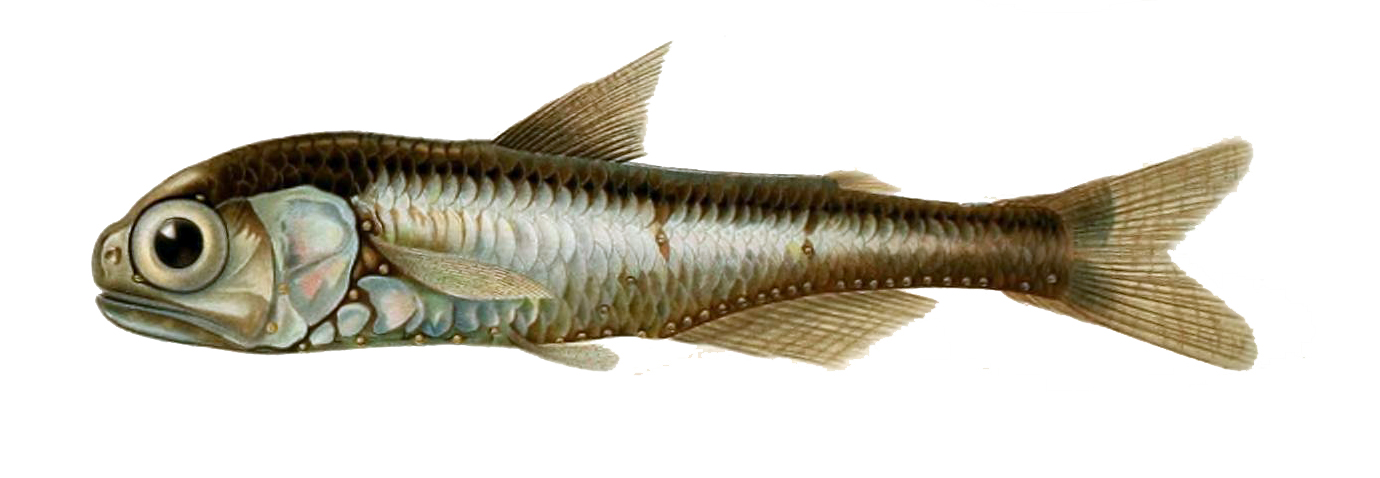
Or are we? Some studies show a massive decline in stocks of certain species and locations, such as those featured in End of the Line, but a newly published study in Nature Communication suggests that those numbers are underestimating the number of mesopelagic fish. These fish, which include the highly prolific lantern fishes, live between 200m and 1000m below the surface of the water. Current estimates predict that fish in this zone make up about 1 billion tons of biomass - lanternfish alone account for more than 600 million tons of that
Picture from Emma Kissling on Wikimedia Commons via public domain.
Keep in mind that lanternfish like the one above range from 3 to 35cm, so even if we're talking 600 million tons of lanternfish biomass alone, that would mean at the very least 1.2 trillion fish, assuming that they're each a pound, and I highly doubt the 3cm ones are that heavy. Data from the Malaspinas Expedition (heads up: site is in Spanish) that tracked the biodiversity of the open and deep ocean in 2010-2011 is suggesting that estimate is only a tenth of what's actually out there. I know these fish aren't huge, but 12 trillion fish is a lot for one type of fish.

Moral of the story: start eating lanternfish fillets? Start catching; you're going to need a lot.

10 February 2014

Citizen science emerges through gaming

I think it's fair to say that gaming has become a significant part of the human experience, from athletic events and board games to RPGs and video games. Anyone needing recent proof can look at the examples of Candy Crush Saga addiction and the uproar that ensued when the creator of Flappy Bird decided a few days back to remove the game from the market due to the pressures associated with running such a viral enterprise. At the same time, games aren't just the subjects of obsession but a way to socialize with friends (and make new ones), spark imaginations, and even cure cancer.

Alright, so the last one was a bit of a stretch, but Cancer Research UK teamed up with developers from Facebook, Amazon, and Google to create "Play to Cure: Genes in Space," which could lead to a cure later on. The free game, which is available on Apple and Android products, is based on mapping routes through space to gather the valuable Element Alpha. While players fly through space, shoot down dangerous asteroids, and upgrade their ships, they're actually analyzing genetic data that can be later used for developing cancer treatments. The game itself was developed at a game jam last year, just like the one a few weekends ago but specific to the goal of creating a data-analyzing game for cancer research.


The professor I talked to for my Global Game Jam article is currently working on something similar that uses an adventure-style game to perform taxonomic classification. The line that stuck for me from him was that the goal is to create games that allow people to do something while they play, even scientific work, without realizing it.

Without throwing everyone under the proverbial bus, I think the reason why more citizen science hasn't come to the forefront is because of a lack of interest in putting forth actual work; I have SETI running on my computer as a screensaver, so I'm contributing to their database, but I wouldn't get all hyped up about number-crunching that data myself. However, if the scientific aspect is hidden in a fun format like Play to Cure and the taxonomic one, there could be a lot of potential.

08 February 2014

Scientists still speculating what makes ice slippery

This one accidentally relates to the Olympics too, but only because there is a lot of ice involved with some of the events. Science Friday did a segment this week about what makes ice slick, but what I found interesting is that scientists still aren't entirely sure what allows us to skate, ski, or throw a big rock across it. The general consensus is that there's a very thin layer of water on top of the ice that reduces friction, but how that layer forms is contested.

The segment's guest, who is a mechanical engineering professor, explained that the reasoning in most physics books is actually wrong: they claim that the water is produced by the pressure created by the weight of the person (or curling stone) because liquid water is more dense than frozen water. In reality, it would take a lot more weight than the average skater to create the pressure required. Currently, there are two other possible explanations for the water:

  1. Ice just naturally has a nanoscale layer of water on its surface (we're talking a thousandth of the width of a hair) that provides the slipperiness, or 
  2. The friction generated from the initial movement generates enough energy to melt the surrounding ice.
The former may seem a bit farfetched, but it's been shown to exist even tens of degrees below freezing, so it helps to explain why we can slip on ice not only when it's super cold but even if we're not moving, which the latter wouldn't be able to account for.

Of course, in Sochi, the problem isn't making the ice warm enough to produce that layer (because it's already there…) but rather keeping the venues cold enough, between the subtropical location and the not-so-finished states of the facilities...