Regular posting will resume tonight, but I wanted to make a quick announcement. If anyone has archive-binged recently, you may notice that some of the pictures have changed or been deleted. I did this yesterday to correspond to an article I received regarding photo use and copyright. As a more or less broke college student, I don't exactly have the funds to go against a copyright lawsuit, and even though I doubt anyone would go through my stuff specifically to throw me under the bus, it could very well happen. As such, pictures, graphics, and so on on here from now on are either mine, belonging to someone I know, public domain, or via Creative Commons. I have also applied a Creative Commons Attribution-Share Alike 4.0 International license to mine (though I could've sworn I did that earlier, but it appears I didn't).
Thanks for hanging in there. I'll have a full post tonight.

08 February 2014

07 February 2014
Kicking off the Olympics with science
What else would I do, aside from make corny jokes about how my female axolotl and the host city in Russia are pronounced the same and differ only in one letter?
The CBC has a whole playlist of Olympic-themed science videos, including stats on your chances of making it to the Games and what factors impact performance. They make a good point that I've observed watching sports in general. Football players look like they could crush me by sitting on me, baseball players look like they could throw me, and gymnasts/figure skaters look like I could throw them. There's also the question of age: I understand the body works at an optimal level for only so long and therefore prevents older people from competing in certain sports, but it's getting to the point where you'll have middle schoolers competing in the Olympics and retired before they go to college. At least they'll be able to pay for school, I guess.
Popular Science also has a good amount of Sochi coverage from the cover story of their February issue, "Engineering the Ideal Olympian." It includes segments about wind tunnels used for training ski jumpers (which was of significance for this year because this is the first time women are allowed to compete in the ski jumping event), using race car design knowledge to create a faster bobsled (if only it were for the Jamaican team), and a good chart detailing the common injuries that occur in the Winter Olympics.
With the opening ceremony today, I felt it was necessary to have a themed post, and when I found this video about how Olympian body types have changed over the years, I thought that would be a good place to start:
The CBC has a whole playlist of Olympic-themed science videos, including stats on your chances of making it to the Games and what factors impact performance. They make a good point that I've observed watching sports in general. Football players look like they could crush me by sitting on me, baseball players look like they could throw me, and gymnasts/figure skaters look like I could throw them. There's also the question of age: I understand the body works at an optimal level for only so long and therefore prevents older people from competing in certain sports, but it's getting to the point where you'll have middle schoolers competing in the Olympics and retired before they go to college. At least they'll be able to pay for school, I guess.
Popular Science also has a good amount of Sochi coverage from the cover story of their February issue, "Engineering the Ideal Olympian." It includes segments about wind tunnels used for training ski jumpers (which was of significance for this year because this is the first time women are allowed to compete in the ski jumping event), using race car design knowledge to create a faster bobsled (if only it were for the Jamaican team), and a good chart detailing the common injuries that occur in the Winter Olympics.
06 February 2014
Plagues helped shape human genomes
Genetics has always been my favorite part of biology. I enjoy Punnett squares more than I really should (as I explain in this post about my first batch of axolotl eggs), I got to compare my mitochondrial DNA to an international database that included Neanderthal DNA in my genetics class last spring, and overall I find inheritance and genes to be really interesting. As such, this post from IFLS about how the Black Death tweaked European and Rroma genomes was something I wanted to look into.
What these researchers found was that the presence of Yersinia pestis, the bacterium responsible for killing off more than 20 percent of the world's population at the time, selected for genes involved in the immune response, specifically a Toll-like receptor that helps in the pathway to tell the cell that it is under attack. As one might guess, people in the 1300s who didn't have these genes were killed by the plague, while those who did survived and passed on these genes to their children. It's natural selection for humans.
The cool part? This selection happened in two genetically distinct populations. While Europeans and Rroma both lived in Europe, the Rroma were originally from the northwest corner of India, so their initial geographic isolation from the native European group provided for a greater genetic diversity between the two groups. However, because they occupied the same space during the wrath of the Black Death, both were subject to the natural selection process above, thus picking out the immune people from both populations. Because these genes came about separately (geographic isolation and all), this shows convergent evolution; another example of this process would be how birds, bats, and bugs all have wings, but they all developed them separately rather than inheriting them from a common flying ancestor.
What these researchers found was that the presence of Yersinia pestis, the bacterium responsible for killing off more than 20 percent of the world's population at the time, selected for genes involved in the immune response, specifically a Toll-like receptor that helps in the pathway to tell the cell that it is under attack. As one might guess, people in the 1300s who didn't have these genes were killed by the plague, while those who did survived and passed on these genes to their children. It's natural selection for humans.
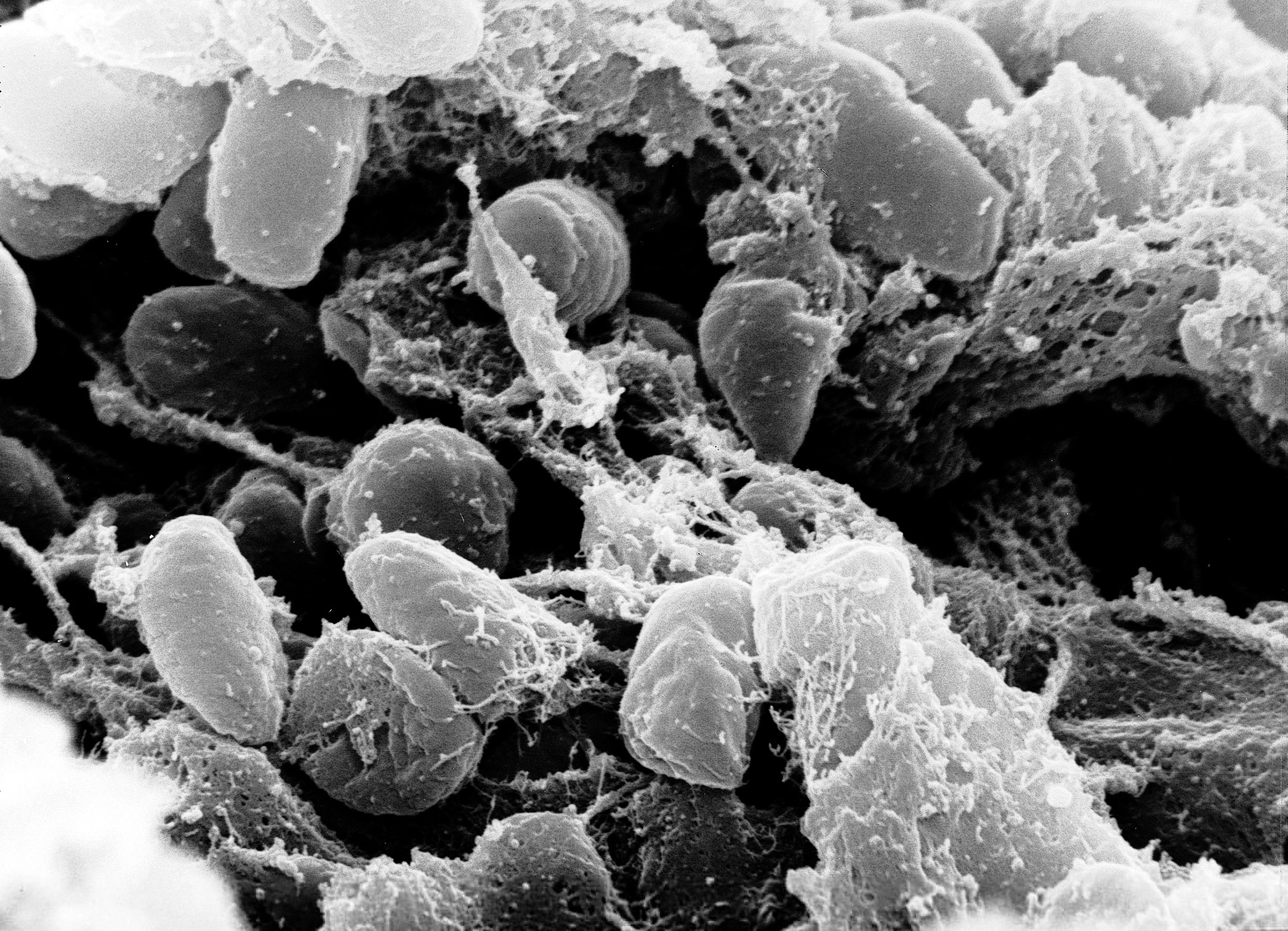 |
| The nasty little bacterium responsible for decimating Europe. Public domain photo from the NIH |
So no, we don't have bacterial DNA in our genome (… alright, technically we do because some of the genes are the same for all organisms, but you get my drift), but this goes to show that even a small organism like this can bring about large changes in human genetic history.
05 February 2014
Science and religion go head to head in creation debate
I had all intentions of watching the creation debate between Bill Nye and Ken Ham yesterday, but the combination of a Spanish paper and the YouTube page crashing my computer prevented me from watching it and thus covering it until now. I've since caught bits and pieces, and in addition to seeing other commentaries on it, I'd like to address a few things that I feel make this discussion worth having.
Regarding bias, I feel it's pretty obvious where I stand in this debate, between my explicit interest in science and my "not so explicit but potentially assumed" status as an atheist, but I will do my best to keep this as civil as possible because nothing can get done otherwise. Also, for simplicity's sake, I'll refer to the people on Nye's side as "evolutionists" and Ham's side as "creationists" because while Nye is a scientist, there are scientists who may not believe in evolution (which, admittedly, is a stretch, but for the sake of the argument).
Regarding bias, I feel it's pretty obvious where I stand in this debate, between my explicit interest in science and my "not so explicit but potentially assumed" status as an atheist, but I will do my best to keep this as civil as possible because nothing can get done otherwise. Also, for simplicity's sake, I'll refer to the people on Nye's side as "evolutionists" and Ham's side as "creationists" because while Nye is a scientist, there are scientists who may not believe in evolution (which, admittedly, is a stretch, but for the sake of the argument).
- Evolutionists are more willing to say "I don't know," and creationists need an explanation for everything. This was made apparent in this Buzzfeed article that was in my news feed, in which the author asked creationists at the debate to pose questions to the evolutionists. The lady in photo number 9 illustrates this point very well in her question, "If God did not create everything, then how did the first single-celled organism originate? By chance?" Evolutionists would say yes, and creationists would say that such an instance couldn't possibly happen, hence the position of God as creator of these organisms.
- Evolutionists are more open to changing their outlook, and creationists are solid in their beliefs. Part of the scientific process is revisiting old hypotheses and changing them if outcomes or observations refute them; as such, scientists would be willing to accept another hypothesis were evidence to arise that disproved evolution, whereas no amount of evidence supporting evolution will change a creationist.
- Only a minor thing, but the creationist side can't really claim persecution in education when the educational systems that teach creationism only look at the Christian story. Other beliefs are snubbed, as demonstrated by a quick Google search of "creation story."
 This seems to fit in with the bit of not changing what they think when other options are provided.
- This is probably the most important, but science and religion aren't completely separate. I know people who are comfortable in their faith and still accept evolution as more or less fact, and even though the church system seems to be anti-science in some respect throughout the ages, some of the best science has come out of it. Take Mendelian genetics for example: without it, we wouldn't know how inheritance works, yet Gregor Mendel was a monk.
As always, I'm open for discussion. What are your thoughts on the debate, evolution, or creationism?
03 February 2014
Japanese researchers develop new way of creating stem cells
This is pretty monumental, and I'm kicking myself for not getting to it sooner. Stem cells, specifically pluripotent stem cells, are a current scientific target because they have the proverbial "blank slate:" like a theoretical infant that can become a doctor, firefighter, or animal trainer, these cells can differentiate into anything in the future, be they stomach cells, brain cells, or blood cells. As such, they are extremely useful, such as in organ regeneration and transplants (another issue close to home, plus they covered it tonight on the Science Channel), but at the same time, they are surrounded by controversy because for the longest time, the only source was embryonic tissue.
As published last week in Nature, a team of scientists in Japan have found a way to reprogram body cells into pluripotent stem cells. They determined that exposing mammalian somatic cells to a strong external stimulus, like acid, reprogrammed these cells without the introduction of a new nucleus or different molecules to transcribe the DNA into RNA. This was a previously unknown mechanism, but further studies showed that these reprogrammed cells, called STAP cells (STAP standing for stimulus-triggered acquisition of pluripotency), have a lot less DNA methylation. While somatic cells would normally have genes not applicable to their function turned off (i.e. a nerve cell turning off eye-related genes), STAP cells don't have as many genes turned off and can therefore fill different functions.
Admittedly, I'm most excited about the use of this for organ regeneration because this would reduce a lot of transplant-related problems. For example, it can allow doctors to take a donor's heart, take out all of the muscle cells it so only the connective tissue is left, and fill in the heart with the patient's own muscle cells (here derived from somatic cells that were converted into STAPs and induced into being muscle cells). This would prevent any chance of rejection because it's the patient's own cells and thus allow the patient to carry on without having to take anti rejection meds and then be restricted as to what they can do.
02 February 2014
NFL experts (finally) recognize the dangers of concussions
Super Bowl football Broncos Seahawks yay rah rah. I spent the game at rehearsal and playing the online version of Cards Against Humanity. I've never been a huge fan of football in general; I only know as much as I do from four years of high school marching band and a gym teacher who was more forgiving to the less athletic among us and gave us comprehension quizzes rather than grading by ability. What I do know is that people care way too much about it (i.e. our HS football team got new jerseys every year while the softball team had to buy their own med kits for crying out loud), and that it is a lot more dangerous than people like to think.
I think it's a false sense of security. Before you even leave the locker room, you drown yourself in "protective" padding, and then you put a big bowl around your head with only enough holes to see through and barely hear through. Because of these extra layers, players think they can ram into each other like bumper cars because they're "protected," yet we're seeing more injuries and deaths related to neurological trauma. Sure, going full-force into another person without the gear would do a lot more damage, but it's not going to protect you from everything.
Finally, the NFL is starting to recognize that hey, concussions and traumatic brain injuries are a real problem. The NFL Head, Neck, and Spine Committee have been working not only to make the game safer but also to spread awareness of the dangers of these injuries. These have included informational posters in middle- and high schools, sideline neurologists, and advocating for a "when in doubt, sit them out"-type law in youth football that has passed in every state but Mississippi. The committee is also working to raise awareness for concussions in all activities using football as a role model of sorts.
Unfortunately, it has taken a multimillion-dollar lawsuit from former players and the deaths of others to bring this to the limelight, but the sooner they deal with this, the better.
01 February 2014
FAA approves astronaut training program
I'm still mesmerized by the programming that NASA, ESA, and other space-based research has put out. I mean, we've put people on the moon, rovers on other planets, and probes beyond the reaches of our solar system. We have telescopes that can see billions of light years away in wavelengths beyond human perception. And now we have astronaut training for the general public.
Waypoint 2 Space, which is based at the Johnson Space Center in Houston, just got FAA approval for multiple space training programs. These are broken into 3 parts:
Waypoint 2 Space, which is based at the Johnson Space Center in Houston, just got FAA approval for multiple space training programs. These are broken into 3 parts:
- Level 1: Spaceflight Fundamentals. It's a one-week intro course in astronaut things like suit fittings, G-force and microgravity activity, terrain navigation with rovers, and physiological effects of being in space.
- Level 2: Sub-Orbital Training. This one is three days and covers how to deal with the effects of rocket-powered flight, like G-forces and weightlessness, as well as how to handle any emergency situations like hypoxia or smoke.
- Level 3: Orbital Training. The most intensive part of their offerings, this lasts eight weeks or twelve weeks with training outside the orbiter. It prepares trainees for life in space with an emphasis on test scenarios for situational awareness, like if they were to become disoriented depressurized.
These trips aren't cheap; Level 1 training runs around $45,000, and the other two aren't available to the public just yet. However, I think it's a great opportunity for people to give space training a go, and it's a lot cheaper than the Virgin Galactic trip (though admittedly that would be really cool too).
Subscribe to:
Posts (Atom)