Pages

05 January 2014

Sea star stomachs and shellfish saving

When I worked at the science museum near school, one of my jobs was to help man the tide pool touch tank. We had a few different kinds of hermit crabs, some engineer fish, pencil sea urchins, and chocolate chip sea stars, and we had a separate tub that we would put some of the critters in so the kids could touch them. A lot of times, we'd feed them the morning of touch tank days so the sea stars in particular would stay put on their rock (otherwise, they'd roam around the tank), and sometimes we'd be lucky enough to have one of the stars do a backbend off the side and show their digestive process.

Picture from Frans Xaver on Wikimedia Commons via CC Attribution-Share Alike
A lot of people would get grossed out, but I enjoyed explaining to everyone that sea stars eat by expelling their stomachs through their mouths, wrapping them around their food, digesting it externally, and sucking the juices back in. Generally they'd be nomming on clams for this process, which tended to gross out the already grossed out even more.

In a Science Take by the New York Times, researchers have determined the mechanism behind this external digestion process. They knew that a muscle-relaxing neuropeptide was responsible for the expulsion and posited that a counteracting neuropeptide would reverse the process; neuropeptides in the NG peptide family, which trigger contraction, were tested and proved to retract the stomach.

Such knowledge may be applied in the future to help control sea star predation, as they can take out coral and shellfish populations that are both ecologically and economically important (not to mention protected, in the case of corals). And if it works with sea stars, they might want to extend it to other echinoderms, considering how sea urchins are notorious for taking out marine flora too.

04 January 2014

Regional dialects: not just for humans

A few weeks back, I saw the New York Times' interactive graphic regarding regionality in vocabulary choices. As someone who has lived in the northeast all but two years of her life, I wasn't surprised to find that my test results showed a combination of Yonkers, Springfield, Worcester (or as we say here, Wustah), Boston, and Providence.

See? Right at home.
The quiz included questions including how to pronounce caramel (car-mel), what to call long sandwiches (grinders), and whether Mary/marry/merry rhyme (they do). I get poked fun at at school because of my odd vocab choices, but I enjoy listening for other accents and dialects because of the subtle differences that separation can cause; it's allopatric speciation for your speech, and I'm already a sucker for bio. My lab partner freshman year was from north of Syracuse and accentuated the A in words so much that I became his "leab" partner, and there's a running joke around campus that Long Islanders don't know that dog (dawg) and frog (frahg) rhyme.

And then there are international accents. I have friends from Australia and New Zealand, and I had to try so hard not to squee over their accents when we first met; the latter also sent me the Kiwi alphabet and how to pronounce various words.

What I found out this week was that this isn't unique to humans. I know animals can understand different languages (how else would anyone be able to train their dogs?), but according to the illustrious Sir Patrick Stewart, animals such as cows have their own unique dialects. This is one of those things where I can't tell if the topic is a serious inquiry or a huge joke, but it's entertaining nonetheless to hear him moo in various regional dialects of the UK and the US.

If only people here wouldn't question my Connecticut residency because I actually pronounce my Rs.

03 January 2014

Into the unknown

This is a bit of old news, but a few posts on Facebook piqued my interest about the past and future of space exploration.
This is the first one, from Elise Andrew's "I Fucking Love Science."
The fact that this image exists shows two things, both of which are a little depressing: 1, people legitimately do not know the answer, and 2, people take advantage of the technology we have without thinking about how it came to be. The more we know about space, the more we understand about everything else, and the necessities that arise outside of our atmosphere have led to some pretty important products down here, including emergency and medical equipment. 

The second post was a glimmer of hope. Considering NASA's funding was annihilated, it's nice to see that the European Space Agency has their act together with their Gaia mission. In the footsteps of Hipparcos (High Precision Parallax Collecting Satellite and a play on the Greek astronomer) in 1989, Gaia set out last month to create a comprehensive, three dimensional map of the Milky Way. The current goal is to track the precise locations and motions of 1% of the stars in our galaxy, which may not sound impressive until you remember that the Milky Way alone has 100 billion stars.

From its orbit about 1.5 million miles outside Earth's orbit around the sun, Gaia will be able to observe its one billion stars without eclipses. Because it'll observe each data point about 70 times, it'll be able to track brightness differences as well as spot any new bodies, such as planets, asteroids, or brown dwarfs. When the mission is over in December 2018, Gaia's data will be combined into "the largest stellar catalog ever made," according to the ESA.

Field trip to L2, anyone?

02 January 2014

Genetic plot twists

It's pretty common knowledge that early humans radiated out of Africa through Europe and Asia and gradually over to the Americas. Nat Geo is currently conducting the Genographic Project, in which participants submit DNA samples to examine not only their own ancient heritage but also the overall patterns of ancestry and subsequently human migration. While this particular project utilizes markers on mitochondrial DNA, which doesn't change as quickly (and was the subject of a no-longer-online blog post I wrote for the school paper), a few other studies are analyzing the entire genomes of early humans.

The combination of studies - one looked at individuals from Luxembourg, Sweden, and Germany, and the other looked at an individual from Spain - suggested that ancient Europe was the precursory melting pot, with a mix of Middle Eastern agricultural societies, local hunter-gatherer societies, and northern Eurasians. Furthermore, each country has a slightly different percentage of ancestry from the three groups: as a person with Scottish descent, I would have more DNA similarity with an ancient northern Eurasian than, say, someone with Spanish descent (which I also have, but that's aside the point).

What I found interesting is that the blue-eyed gene may have actually come from the African hunter-gatherers that migrated to the continent 40,000 years ago. Previously, I had read that the blue eye gene was a mutation in the Baltics 15,000 years ago or so. Of course, that was in an article I had to read for the state standardized testing back in high school, but CAPTs aside, it's neat to think that the gene was a more distant and not distinctly European mutation.

Then again, there's also the lack of a lactose digestion gene in the Luxembourg and Germany individuals. It makes sense, considering they were adapted to a grain-rich diet as hunter-gatherers and hadn't gotten to the cow domestication thing, but considering how much of a staple dairy is in Europe now, it's interesting to think that we didn't start out that way. As such, I am eternally grateful for the Middle Eastern agriculturalists for allowing me to enjoy ice cream.

01 January 2014

New beginnings

Happy 2014! Aside from my lapse in bloggery, 2013 was pretty good, so here's to hoping 2014 can keep up.

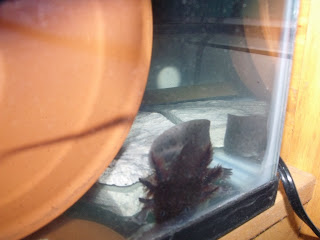
I'd like to open the year with experiential science, specifically regarding my axolotls. I got them in mid-June, a melanoid and a wild-type. They've grown quite a bit since I got them, though I'm not sure exactly how much because I never measured them when I got them, but the tank was always big enough for the two of them to share. The other issue regarding growth was that at the size of their arrival, they were too small to be sexed, and I never put much effort into figuring out how.
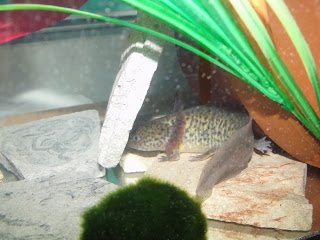
This is Chalchi, my wild-type

And this is Xochi, my melanoid

Of course, I had to find that one out the hard way when the Monday after Thanksgiving I found a bunch of eggs in my school tank. Long story short, I had a lot of fun trying to ship the eggs out to a fellow member of the forum I got the two from in the first place, and I still ended up with quite a few after classmates bailed out. To be fair, they were timed terribly (two weeks before finals), but at the same time, I don't have the time, space, or transporting ability to rear 100+ axolotls plus Xochi and Chalchi.

There was also the issue of separating them: I was able to get another tank for Xochi to live in while I'm home, but my school tank **ahem** already breaks school rules because it's too big, so I have a DIY divider made of needlepoint mesh and rocks for stability planned for when I get back.

And finally the eggs. I found that color is determined by 4 separate genes, and because I enjoy Punnett squares more than I really should, I spent one night earlier this week figuring out the possible combinations of alleles Xochi and Chalchi could have (8 and 16, respectively). Using SciencePrimer's Punnett square generator to save me time and paper, I determined the probabilities of each allele combo of the eggs. Once I got ahold of the lady I bought the parents from from and the guy I sold the majority of the eggs to, I was able to narrow it down to 2 and 4; it turns out that Xochi and Chalchi were from the same batch (oops), their parents were an albino and a leucistic, and some of the other eggs came out as albino and leucistic as well. Here were my findings:
  • Wild - 39.6% (speckled greenish brown)
  • Golden albino - 13.2% (recessive for the gene that controls melanophores; yellow)
  • Leucistic - 13.2% (recessive for the developmental gene that controls color; pink)
  • Melanoid - 13.2% (recessive for the gene that controls iridiophores; black)
  • Melanoid albino - 4.4% (recessive for the iridiophore and melanophore gene; very pale yellow)
  • White albino - 4.4% (recessive for the developmental and melanophore gene; white)
  • Axanthic albino - 0.9% (recessive for the melanophore and xanthophore gene; white)
  • And then a bunch of other ones that weren't important because they didn't have named colors and their percentages were too small.
The road block I'm at now is regarding food. The holidays messed up the shipping schedule for their food, plus some of my eggs hatched earlier than I was expecting, so now the hatchlings are in the fridge while I wait for their food to come in. It doesn't help that pet stores sell brine shrimp in every form but eggs, or that everyone still buys out all the Sea Monkeys for Christmas. (Fun fact: they're actually brine shrimp.)

Struggles aside, here are the things I've learned:

  • Find a forum of fellow owners. They are an indispensable source of knowledge and will help you in the tightest of pinches.
  • Know how to sex your animals if you're going to put more than one in a tank.
  • If you're not ready for eggs, don't put them in the same tank, even if they seem too small to breed. Mine were less than a year old.
  • Refrigerators are your best friend. Unhatched eggs will go into hibernation mode.
  • Buy food for the hatchlings a week before you're expecting them to hatch. They will hatch early.
  • And don't freak out. Concern is good, but stress is not.
If the hatchlings survive their refrigerator adventures, I'll post about them again. And if you want one, let me know.

30 December 2013

Please excuse my distraction and sporadicity

(See what I did there?)

Two jobs over the summer will kill work ethic pretty quickly, and so will 18 credits of classwork and 20 hours of work a week during the fall semester. As such, I apologize for the huge lapse in coverage, and I'm hoping for daily coverage starting Wednesday. Considering this resolution is not fitness-related, it shouldn't fail right off the bat.

Life in meatspace has been pretty busy. Like I said, I had a full-time IT job all summer, plus a night job at a local baseball stadium from June until I left in August. I also acquired two axolotls myself, Xochi and Chalchi, and while they're not the brightest crayons in the box, they're fun. Aside from that surprise batch of eggs the beginning of December, that is, but I sold most of them and kept a few to raise myself. I'll probably blog about their progress from time to time, as they're starting to hatch now. And I started two new jobs at school: one in the IT department doing more or less what I did over the summer, and one at a librarian at the other university in town. The latter replaced my position at the local science museum, which was a blast but had to be relinquished to let another student work there. There are some questionable views in the library's food, medical, and education sections (including a book on how vision problems are caused by shutting out emotional problems…) but overall it's enjoyable.

And with that, the bloggery resumes in two days :)

01 June 2013

Close encounters of the rocky kind

Considering all of the apocalyptic "threats" that have occurred in the past few years, I'm surprised that none of the crackpots picked yesterday's asteroid passing to play on. The 1.7-mile asteroid, named QE2, was discovered in August 1998 by MIT's Lincoln Near Earth Asteroid Research program in Socorro, New Mexico. An asteroid of this size, should it hit Earth, would be catastrophic, but at its closest yesterday around 5pm Eastern time, it was still 15 times farther away than the moon, so there was no chance of it hitting us.

One of the neat things about this asteroid is that it is one of the few that have their own moons. A rock about 2,000 feet long orbits 1998 QE2, and in radar images, it appears brighter than the asteroid itself because it rotates a lot slower, which compresses the returning radar signal into only a small chunk of pixels, concentrating it into a bright patch in the image.

Despite NASA's decrease in funding, more asteroid-related programming is planned for the future, including a possible manned mission to lasso one for research, so stay tuned.